Reinventing the Wheel with Generative Design: From Geometry to Function
A toothed rim, a central hub, and a connecting structure that resembles forms found in nature. The image shows a generative design study developed in PTC Creo Parametric 13, a practical example of how computational tools can help engineers rethink even seemingly simple mechanical components.
The starting question is straightforward: where is material actually needed to perform the required function?
In a conventional workflow, the engineer defines a geometry and then assesses its behaviour through structural analysis. Generative design changes part of that sequence: the engineer specifies the available design space, regions to preserve, materials, loads, and constraints. The software then develops a material distribution consistent with the defined objectives.
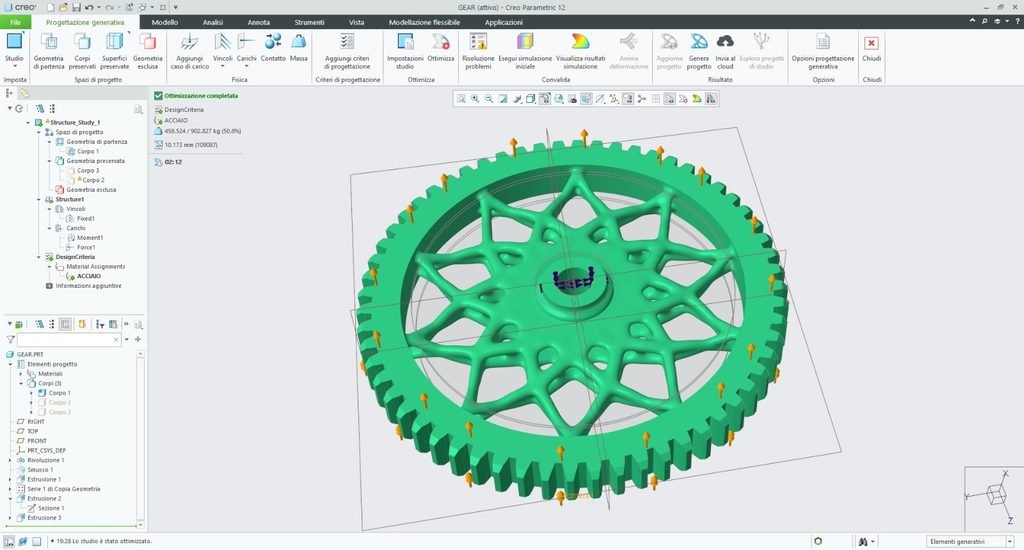
In the example shown, the toothed rim and hub remain recognisable, while the intermediate region takes on a complex arrangement of ribs, fillets, and openings. The resulting shape suggests load paths that differ from those of a conventional solid-disc wheel or a wheel with regularly spaced spokes.
The results panel indicates a final mass of 50.8% of the initial value, corresponding to a reduction of approximately 49.2% within the analysed model. This is an interesting result, but it must be interpreted within the study’s assumptions. It does not automatically establish an advantage over an already optimised conventional wheel, nor does it alone demonstrate suitability for service.
This is where engineering judgement becomes essential. The result depends on which loads are considered, how connections are represented, and which operating conditions must be satisfied. For a gear wheel, relevant considerations include torque transmission, tooth stresses, fatigue, deformation, and—where significant—rotational effects. A geometry that performs well under a single load case may require changes when the full operating cycle is considered.
Manufacturing is also part of the design problem. Creo allows geometric and manufacturing constraints to be incorporated into the generative study; the resulting solution must then be assessed against the selected production process. Tool access, wall thicknesses, tolerances, surface finishes, and costs all influence which geometries are commercially practical. A branching structure can therefore provide the starting point for further development into a production-ready design.
For Altamax Engineering, the value of this approach lies in bringing together CAD design, simulation, and manufacturing assessment. Optimisation provides new solutions to explore; engineering experience makes it possible to interpret, verify, and develop them into manufacturable components.
“Reinventing the wheel” thus becomes a practical engineering exercise: questioning a familiar geometry, understanding how it carries loads, and seeking a better balance between weight, performance, and cost.